Final Week: Progress update and Evaluation.

For the final week, we decided that we needed new logos/UI for the start screen and end screen. I recreated my Prototype logo with changes and hand painted text for the title screen. The wheel is still reminiscent of a cog, but the sunflower felt more appropriate, especially as we recently scrapped the robot wasp concept due to lack of time to complete unlike the caterpillar enemy. The sunflowers feel more iconic to the game as this is what you are planting to keep enemies from stealing the coins. The particle effects make it feel more magical and imitate the particle effects present in the game.

Title Artwork.

In-Game screenshot.

The ‘Game Over’ art are surrounded by painted coins (the coins ingame are made by Asa Booth) to represent the coins stolen by the robot caterpillars, with the number of rounds completed. Overall I wanted the colours to be similar to Mabel Corsi’s UI art, which was predominately purple and blue. I wanted the colours to stick out ingame well enough to be clear, because the title art will be on the game background so it needs to stand out.

Game Over screen. The ‘Days Survived’ text was not included in the final game.
I think I should have made the text darker or lighter – I did not realise the background would still be the game over screen as well. I will learn this for next time as there is no time left now to fix it.

Overall I think the game visually is strong. I’m very happy with how my collaborations went and how the room has been faithful to the concept art. Drawing all of this was out of my comfort zone because I was not used to drawing more simple cartoonish styles in such a subject matter. I have learned a lot working with other people and will learn from mistakes for next time. The mechanics have improved over time even though a lot of decisions were made late, and all in all it was a fantastic learning experience. I have not done UI before and managed to practice offset textures too, so I will be able to improve that for next time.

For the group, I feel that the scope was initially too big and although I tried to reel it back in, time management was an issue and various aspects of the game were cut. Communication all in all was good within the group, but the deadlines we had were a little too relaxed at times so it meant that a lot of decisions were made late when they should have been made a while ago. There seemed to be a lot of emphasis on visuals, so I was quite worried sometimes that although that aspect was strong, the mechanics still lacked at times. I would have preferred a stricter schedule and feel that hard decisions should not be left. Another thing is that sometimes the workload on other team members was hefty, and others had nothing to do. I personally always found something to do, but some weeks were certainly more relaxed than others. Planning and scoping better would be beneficial for the future, but this collaboration project has been a great learning experience.

Weeks 7, 8, 9: Progress update

From my previous post, I had painted a sunflower indicator for the ground and also UI, and Asa Booth worked on a potted sunflower, using my art as reference and inspiration to stick to the style and theme of the game. Below is the final textured plant, which I believe is very faithful to how I had envisioned it to be.

Asa Booth’s Sunflower.

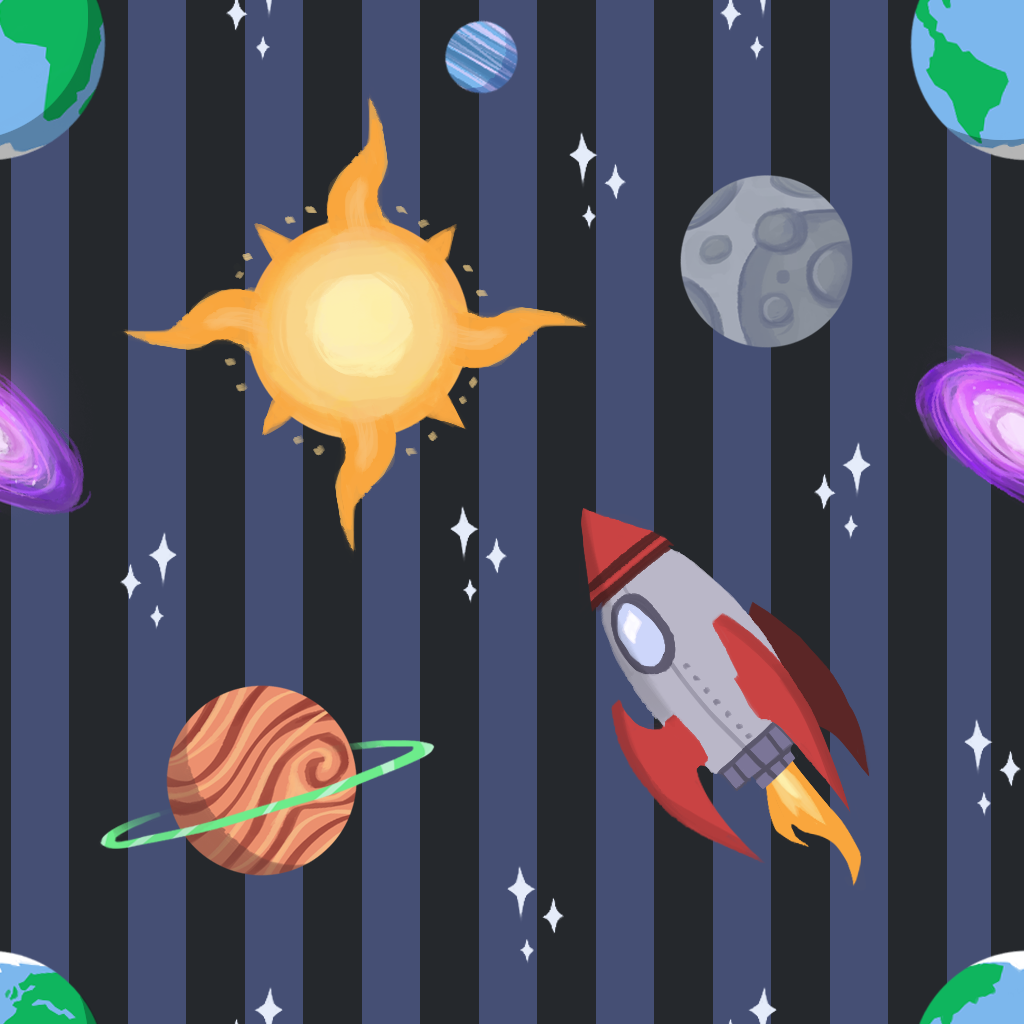
For the Ninth week I completed another painting for a children’s poster inspired by the Space theme and referring back to the art style of both the bed texture and dinosaur poster I created. I am rather pleased with this one, but I think I could have painted the reflected lighting better on the glass window as well as cast shadows in a different way.

Asa Booth again added the texture to the deformed plane and masking tape with the same technique and I think it works really well. The final poster can be seen below.

As for the game, I stayed at university with Asa Booth to playtest some of the game and also rearrange the scene and help with art direction and lighting. The notes below are mainly the changes I was present for and aided Asa with, suggesting ideas and solutions.

02/05/2019 Notes on changes (written by Asa):

  • Removed coins around the chest due to the player not being able to pick them up.
  • Changed the enemy path blueprint so that the mesh always faces upwards.
  • Added a mesh specifically for the enemy path blueprint.
  • Changed and added the texture for the enemy path material.
  • Adjusted the room as the desk didn’t fit under the window – the drawers are now under the window instead.
  • Changed the lighting to give the scene more warmth and to match Anna’s concept art.
  • Removed some assets from the scene that aren’t being used.
  • Removed any unused materials.
  • Removed some unnecessary lights for optimisation purposes.
  • Removed the lights on the ammo pickups as they are heavy on performance.
  • Added folders to the world outliner and organised any important elements.
  • Adjusted the bubble material so it looks more like water.
  • Applied the same bubble material to the ammo pickups for clarity.
  • Removed some unused blueprints.
  • Fixed plant watering.
  • Added reflection captures to the scene.
  • Added walls behind the door so the player can’t see the skybox.
  • Changed the scaling of the floor so that the texture isn’t stretched.
  • Fixed the texture coordinates of the floor material so that the normal and RMA matches the albedo.
  • Added a pulsing emission effect on the coins to bring attention to them.
  • Changed the level to accommodate AI paths and changed the AI path splines.
  • Implemented the planting tooltip so that players know what button to press to plant a sunflower.
  • Added proximity-based dialogue pop-ups to the dinosaurs that help the player learn the game.
  • Added UI for the keybinds onto the main menu.
  • Added Lava_Lamp_01a and material.
  • Added Fish_Bowl_01a and material.
  • Added a new animated plant material.
  • Fixed the material for the curtain so that the subsurface scattering works correctly.
  • Changed the collision on the beanbag so that the navmesh generation works nicely with it.

Week 6: Progress Update

The textures for the bed covers have been tested in game and they tile well. The bed is currently being created by Asa Booth and Axel Davenport created the duvets for the bed and made sure the textures will not stretch over the 3D surface.

The team and I decided that we need indicators for the ground as well as UI for the remaining number of plants at the player’s disposal, so I painted a sunflower in a similar style as the rest of the art I created, sticking with the themes. I had errors initially with consistency all around as I wanted it to rotate as well, but I managed to fix it although it meant I had to repaint a lot of parts. I showed it to the group after feedback, and it was well received. Asa Booth said he will be creating a model of the sunflower based off of this artwork as well. The sunflower indicator will be spinning on the ground and as you approach them, a ghost version of the potted sunflower will appear. Once active the flower pot with appear normally in the game.

Sunflower indicator (1000 x 1000 pixels like the offset textures).
In-game screenshot.

Over the next two weeks I will be abroad visiting family in Corsica, so unfortunately as I have no computer access I cannot work on any art, but I will do my best to communicate my ideas and thoughts with the rest of the team online.

Week 4 (during interchange) + Week 5: Progress Update

Progress across all areas of the game are fairly strong at this point, so as a group we decided to submit our game for the Norwich Games Festival. However, along with the game description Asa Booth created, we needed a logo for our game, at least a temporary one – and it was needed fast. I tried my best to communicate with the rest of the group and gain outside opinions on which logos were most suited. I needed to combine two elements of the game to create it – plants, magic and nature along with technology associated with the robot enemies.

I wanted to initially involve some themes from the game including the dinosaur, but as this was not the centre point for the game, we scrapped it. However, the most popular choice was a combination of the top second concept and the bottom far right concept, with the leaf clad wheel (the unity of both elements of the game, also reminiscent of a cog). Although you play as the fairy, I felt the wasp would be more noticeable and easily recognisable as an iconic figure for the game. I drew the robot wasp in a similar style to the dinosaur, and recreated the leaves. I was going to leave them plain, but the group really liked my experimentation of adding shading.

Logo submitted to NGF as a temporary logo.

Above is the logo I created, but found it was not contrasted enough and the colours were a little desaturated. I edited this for the final game logo as seen below. I am not certain if it is my vision, but it slightly looks to me as though the inner ring is slightly too far towards the top left of the logo overall, and I tried to fix it but it is difficult to tell. It may be wise next time to take a different approach with different techniques as there is also visible pixelation. However, I have decided to leave it for now as I need to move on with other works and this logo needed to be submitted quickly as I was under pressure.

Final Prototype Logo

Once we were all satisfied with the Prototype logo and we finally applied for NGF, I decided to continue to aid with texturing. On the original mood painting I drew a rough dinosaur poster. To decorate the room I have decided to create at least two posters (it depends how much space is available on the walls, because as the bedroom level was far too big at first, we tightened the area and we continue to reorganise assets and such). Continuing with the theme, just like on the bed covers I created, I created the first poster this week. I continued with the cartoon style and painted textures, trying to keep the design as simple as possible for clarity and due to the nature of the childrens’ age range and interests.

The texture I created.

I calculated the pixels for how large the average poster dimensions are, and stayed within this requirement. Asa Booth created the deformed plane and I asked him to add masking tape to make the poster more childish as well as weather the faded and beaten poster and make it look as though the poster is hanging slightly off the wall. Below is the final product, and in situ I am very pleased with how it looks.

Final poster
Poster in situ (asset test room)

Course interchange week: Learning the basics of After Effects.

Before I came to university, I had studied animation as well in college, and had used some software such as Flash (and even Photoshop) as well as learned traditional cel animation, but outside of my work in my personal time I also have an interest in creating small comics, animations or animatics occasionally alongside my concept art and illustrations. I am also very inspired by animated paintings such as the login screens in Riot Games’ game League of Legends, for example, and would like to one day create an original one that is similar. I wanted to learn how to use Adobe After Effects, and so when I came across this interchange workshop, I snagged the opportunity to learn the basics to at least get me started.

I began to learn how to navigate the timeline and refresh my memory of different tools and techniques which were transferable from programs I have used, learning how to use tweens and how to move, expand and slide text, imagery and video clips as well as how to change clip colour. I learned about layering and using key frames to animate a puppet which I found useful as well as applying bones to images and animating them (which I discovered could be a useful technique for animated paintings as mentioned earlier). I have issues uploading the video of the puppet onto youtube, but I will share that clip I animated below from my drive. Overall, I found the workshop enjoyable and helpful, and I would like to learn more about the software as well in my own time.

Link: https://drive.google.com/open?id=1Kp-ysQsvtpdiXpQXfmWZw2GWsc63sXmz

Week 3: Progress update

My team mate Karl Brockhurst needed a model sheet for the wasp robot design, so I created one in full colour. I explained certain materials to him, that the body is metal, the wings ‘glass’ that glows and the antenna are LED lights. The limbs and stinger also glow as though the metal had been heated, making them more deadly. We have been discussing about different enemy types including one that fires from the ground, but as we want to keep it simple, we chose only one other enemy type, which is a robot caterpillar, and Mabel Corsi has been working on that, in which its design is inspired by my robot wasp. The model sheet I created can be seen below.

Meanwhile, as assets are being created following the theme of dinosaurs and outer space, I created two textures for the childrens’ duvet covers on their beds. I initially encountered issues with the offset panelling and arranging the pictures but with practice I remembered how to achieve the result I wanted from what I learned back in year 1. Thankfully, the textures in-game tile really well, which I am pleased about. I will continue the cartoon theme throughout other textures I will be creating. The dinosaur texture was the first one I completed, and while the second texture tiles similarly with the stripes I tried to experiment more with a painted style.

Texture 1: Dinosaur bed.
Texture 2: Space bed.

Week 2: Progress Update

I continued to work on the wasp enemy design, and created various colour variations. I experimented with traditional colours with the blue and gold initially, then shifted across the colour wheel towards more warm colours while experimenting with different metal colour types. I showed the rest of the team as well as students outside of our team and so it was decided we would use the third colour iteration, which is red and dark silver. The colours make it stand out against the night lighting and seem more menacing and fiery. The design initially was going to have a glass needle like stingers with liquid poison for the plants, although this may be difficult to achieve, so we are sticking with metal stingers that glow hot orange like the rest of the limbs instead.

I managed to create initial visual mood paintings for both the day and night cycles. These may not be faithful to the final product, but I made it so we have a basic idea at least for assets and how I imagine lighting appearing. I chose a warm atmosphere to give a sense of safety and comfort in a dream-world like room compared to the more ‘nightmarish’ dark night when the wasps will invade.

The day and night concepts shown are paintovers of the bedroom blockout (shown above), which are shown below.

Daytime lighting concept art.
Night-time lighting concept art.

Week 1: Prototype and personal progress

Continuing from my previous post, our group decided upon a basic child’s bedroom, but were stumped on the aesthetic initially before going with a simple bedroom reminiscent of our memories harking back to the 90’s to early 2000’s. We are planning on how our mechanics should work and refining ideas, although it seems like a lot to produce from the drawing board at the moment. The basic idea to have the fairy, our player character, by day going around the room to water plants as well as collect items and by night defending the plants from enemy robot wasps that try to attack them. This perspective of the smaller characters is how our project relates to the brief title ‘Tiny Worlds’.

Overview of the bedroom blockout. However some furniture may be rearranged with purpose to compromise for level organisation based around mechanics.

I believe that thinking about scope and how everything at the same time will be executed is important and whether it will be achievable, as much as I also have faith in my team mates. The concept for our mechanics currently seem like it will prove rather challenging to create through the process, as by the end of the prototype while we do have ideas, we do not have a firm grip on what we want the mechanics to be exactly. We have discovered problems with how our decisions could impact gameplay, readability and ‘fun’. There is a lot of repetition and concentration on certain areas of the level that could prove to make the gameplay boring and without purpose at this current point. It is worth thinking about adding penalties and organising the level better.

At the same time, my group and I as a concept artist have been also discussing our game’s aesthetic, and were unsure initially whether to go more realistic or cartoonish. We quickly decided on a more playful cartoonish style overall, since it appeals to a younger audience and reflects back to childhood memories that everything seemed bigger, hence the use of exaggeration. I started sketching iterations of the enemy wasp, which is surprisingly the first asset I designed to help us have a feel for the rest of the aesthetics even though the fairy is the player character and therefore also important. We are also planning on other enemy types as well, perhaps two or even three, but we are focusing on one for now. Our other concept artist, Mabel Corsi, is designing the fairy at this point.

The thumbnails I created of the first enemy type: robot wasps.

There was a fine line between attempting to make an enemy appear menacing with a more triangular body shape while having rounder features to make it appear ‘cute’ at the same time. I was considering with our 3D artist, Karl Brockhurst, if the evolved thumbnail design is achievable as the design was met well with other people, and he said yes, and so I will work on colour iterations and also a model sheet later down the line while a block out is in place. This is due to the fact that it is rather critical I work on mood paintings for how our room should appear quite early on.

Week 1: Initial ideas and thoughts.

The first day largely involved our entire group sitting and discussing our various different ideas that eventually culminated in a collective blend of our ideas. It was originally more driven towards horror and sci-fi, but also fantasy. However, instead of horror we decided on a game genre more driven by early memories of our own childhoods, a nostalgic twist on the visuals with mechanics similar to retro 3D games and even films such as Toy Story that we used to watch and play.

The sweet memories of running around what I, or even we, believed were magical gardens with hidden fairies and mythical creatures, our curiosity over the strange insects that made it their home, and the invasion of new and exciting technologies; I reminisce my obsessions with watching VHS tapes on a clunky CRT television that belonged to my older brother and sister from the 90s, playing with plush toys and reading books about robots, dinosaurs, outer space. I also recollect playing with my best friend at the time on their old SNES console, wasting the afternoons away without a care in the world. At the time these were what made those endless summers so wonderful, thinking I’d never grow up with every night I went to sleep and dreamed.

Nostalgia is a fascinating concept that we were all fond of as a group, and so we clung to this idea at the root of our game concept. We decided on a bedroom belonging to twin children – and while a confined space acting as a level, this space is not limited to reality itself, as evident by the children’s imaginations in breathing life into the magical fairies and the robot insects. Perhaps they only exist in a ‘dream world’, as the children are not present so this leaves questions for the player, but they certainly matter at the heart of the children’s minds within the place that should be safest to them.

Perhaps there are events in the real world that these mechanical insects represent that cause the nature and magic to start collapsing, causing problems for the children who may be trying to fight back or cope. This idea also came from the fact that I played outside less as technology entered my life more and more as years went by as I became older, and I therefore did not appreciate nature outdoors so much. The insects robbing this from the fairy and escaping the room is also reminiscent to me of how I started growing up and becoming more aware of the world outside of my imagination and mind, and often finding ways to retreat back to memories of a more carefree time and my own imagination through my artwork. The irony of this is that I enjoy bringing this back around and pushing my imagination and ideas from my mind back into reality through my work to share with others, and therefore, my contribution as a group member to this game project will be a realised representation of these thoughts to me.

Brocklehurst Studios: Our collaboration project at Norwich University of the Arts.

Hello! I’m Anna-Maria, and I am one of two concept artists out of our small team of seven students who will be working on a game for the next several weeks until May. We are comprised of two concept artists, three asset production students and two Indie Dev students working with Unreal Engine.

The brief given to us was called ‘Tiny Worlds”, which gave us some leeway into how we could formulate an idea in relation to this and from what perspective. Initially our team has to create a prototype for a week and then continue forth and build upon what we have. This journal will document and reflect upon my own progress as part of the group as well as decision making between the seven of us. Today we are discussing in a meeting our ideas and will commence with this upcoming week.

We have set up a Trello board to track our progress. Here is the board link:
https://trello.com/b/n9wKlXUy/team-1-brocklehurst-studios

And the invite link: https://trello.com/invite/b/n9wKlXUy/6f624d04b8979d57f36d525a4fa88c4b/team-1-brocklehurst-studios